

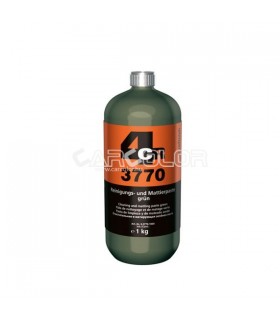

Last items in stock
12,129 Ft
(tax incl.)
Online price
Matting compounds are designed for surface preparation before refinishing and paint repair. They help create an even matt finish on existing coatings, supporting proper preparation before the next paint layer is applied.
A matting compound is used to prepare existing painted or clear-coated surfaces before refinishing. It helps reduce surface gloss and create a more uniform finish before another coating is applied.
Matting compounds can be particularly useful on edges, curves, recesses and other areas where conventional sanding can be less convenient.
Proper surface preparation is essential before paint repair or refinishing. The existing coating needs to be clean, suitably abraded and prepared for the next layer.
A matting compound helps create a consistent surface texture. Its purpose is not to create a decorative matt paint finish, but to prepare an existing coating for subsequent refinishing work.
A matting compound can be useful when:
Matting compounds are commonly used with a suitable abrasive or scuffing pad. The combination helps distribute the abrasive action evenly across the surface and can make it easier to prepare complex shapes and difficult areas.
Select the pad grade according to the existing coating, the required preparation level and the refinishing system that will be applied afterwards.
Always start with a clean surface. Wax, grease, silicone and other contamination should be removed using an appropriate cleaning and degreasing process before matting begins.
Work the compound evenly over the surface with the selected pad until glossy areas have been removed and a consistent matt appearance has been achieved. After preparation, remove all residue and clean the surface as required before continuing with the paint process.
Application methods can vary between products, so always follow the manufacturer's instructions for the specific matting compound being used.
These products are not direct substitutes in every situation. Sandpaper is more appropriate when controlled material removal, defect correction or a specific abrasive grade is required.
Matting compound is particularly useful for fine preparation of existing coatings and for complex surfaces where uniform hand sanding can be more difficult. Both methods may be used at different stages of the same refinishing process.
It is mainly used to prepare existing painted or clear-coated surfaces before refinishing. It helps reduce gloss and create a more uniform surface for subsequent paintwork.
No. Its primary purpose is surface preparation rather than decorative finishing. It temporarily mattes the existing coating so that it can be properly prepared for further refinishing.
In many cases, yes. A suitable abrasive or scuffing pad helps spread the product evenly and improves control during surface preparation. Always follow the recommendations for the specific product.
Not in every application. Matting compound is mainly intended for fine surface preparation, while sandpaper is used when more controlled abrasion, defect removal or a specific sanding grade is required.
Yes. It can be useful for preparing surrounding paintwork before repair or blending. Always make sure the preparation method is compatible with the paint system being used.
Please sign in first.
Sign inCreate a free account to save loved items.
Sign inCreate a free account to use wishlists.
Sign in
 English
 Magyar
&media=https://www.carcolor.hu/shop/6493-large_default/4cr-cleaning-matting-paste-green-1kg.jpg)


&media=https://www.carcolor.hu/shop/2835-large_default/corcos-matt-gel-1000ml.jpg)