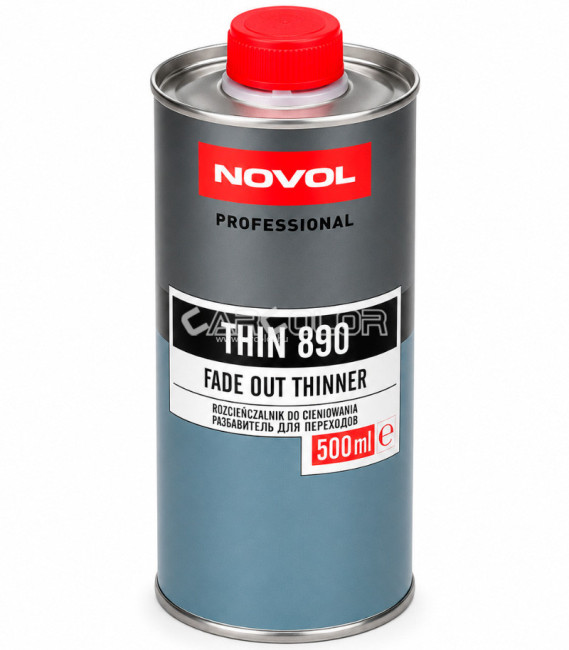
NOVOL THIN 890 Fade-out Thinner
NOVOL THIN 890 is a special fade-out thinner developed for creating smooth transition zones when applying clearcoats and acrylic topcoats. Its purpose is to reduce visible optical differences between the old and new coating and to create a smoother transition area that can be polished more easily after curing.
The product is especially useful for spot repairs, partial panel refinishing and repair processes where the newly applied clearcoat or acrylic topcoat must be blended into the existing coating. When applied correctly, THIN 890 helps the repaired area visually integrate into the surrounding finish and supports easier polishing of the transition zone.
THIN 890 is a ready-to-use product and does not require mixing. It should be applied in thin layers, in 1–2 passes, over the transition area between the existing finish and the newly applied coating. According to the application process, it can be applied after each clearcoat or acrylic topcoat layer, or only after the final layer.
Main benefits
- Provides a smooth transition when fading out clearcoats and acrylic topcoats
- Helps blend the new coating into the existing finish
- Reduces visible colour and gloss differences in the transition area
- Makes subsequent polishing of the transition zone easier
- Suitable for clearcoats and acrylic topcoats
- Ready to use, no mixing required
- Colourless product, does not alter the colour of the repaired surface
- Recommended for professional refinishing work
Product information
| Product type |
Fade-out thinner / blending thinner |
| Application |
Creating transition zones for clearcoats and acrylic topcoats |
| Condition |
Ready-to-use product |
| Colour |
Colourless |
| Viscosity |
DIN 4 / 20 °C: 10–12 s |
| Recommended application |
Thin layers, 1–2 passes |
| Area of use |
Repair refinishing, spot repair, transition zone refinement |
Compatible coatings
| Coating type |
Use |
| Clearcoats |
For smoothing and blending clearcoat transition zones |
| Acrylic topcoats |
For reducing optical differences between old and new coatings |
Spray gun settings
| Spray gun type |
Nozzle |
Pressure |
Spraying distance |
| Conventional gravity-fed spray gun |
1.3–1.4 mm |
3–4 bar |
15–20 cm |
| Low-pressure gravity-fed spray gun |
1.2–1.3 mm |
2 bar |
10–15 cm |
The spray equipment manufacturer’s instructions must always be followed.
Application process
Apply THIN 890 fade-out thinner in thin layers, in 1–2 passes, over the transition area between the existing finish and the newly applied coating.
| Method |
Description |
Recommendation |
| Method I |
Apply a thin layer of THIN 890 directly after each clearcoat or acrylic topcoat layer. |
Recommended method |
| Method II |
Apply a thin layer of THIN 890 directly after the final clearcoat or acrylic topcoat layer. |
Alternative method |
Usage tips
- Apply the fade-out thinner only to the transition zone, not to the entire repaired panel.
- Work in thin, controlled layers, as excessive material may cause runs or surface defects.
- The purpose of the product is to soften the visual transition, not to increase coverage.
- The coating must dry properly before final polishing.
- A test application is recommended with the selected coating system and workshop conditions.
Storage and shelf life
Store in a cool, dry room, away from sources of fire and heat. Avoid direct exposure to sunlight.
| Shelf life |
24 months at 20 °C |
| Storage |
Store in a dry, cool place, protected from sunlight and heat sources |
Safety and important notes
- Read the safety data sheet before use.
- The product must be applied according to professional workshop practice.
- A test application is recommended, as different materials and working conditions may affect the final result.
- The manufacturer’s and workplace safety instructions must always be followed.
















 English
 Magyar
&media=https://www.carcolor.hu/shop/17771-large_default/novol-thin-880-thinner-for-polyester-spray-filler-05l.jpg)


 - OFO&media=https://www.carcolor.hu/shop/15397-large_default/nitro-thinner-5l-ofo.jpg)
&media=https://www.carcolor.hu/shop/15394-large_default/gun-cleaner-thinner-5l.jpg)
 - OFO&media=https://www.carcolor.hu/shop/15388-large_default/universal-acrylic-thinner-5l-ofo.jpg)
 OFO&media=https://www.carcolor.hu/shop/15373-large_default/polyurethane-thinner-1l-ofo.jpg)
 OFO&media=https://www.carcolor.hu/shop/15370-large_default/epoxy-thinner-1l-ofo.jpg)
 - OFO&media=https://www.carcolor.hu/shop/15367-large_default/universal-acrylic-thinner-1l-ofo.jpg)
&media=https://www.carcolor.hu/shop/12934-large_default/impa-1611-polyurethane-thinner-5l.jpg)

&media=https://www.carcolor.hu/shop/9238-large_default/graduated-plastic-mixing-cup-750-ml.jpg)
&media=https://www.carcolor.hu/shop/7963-large_default/3mtm-09545-perfect-ittm-microfine-abrasive-p1500.jpg)
&media=https://www.carcolor.hu/shop/6585-large_default/car-fit-paint-strainers-190u.jpg)
&media=https://www.carcolor.hu/shop/8081-large_default/3m-734-01972-wet-sanding-sheets-p800.jpg)

&media=https://www.carcolor.hu/shop/16680-large_default/car-fit-antirust-primer-grey-1kg.jpg)
&media=https://www.carcolor.hu/shop/8941-large_default/graduated-plastic-mixing-cup-385ml.jpg)
&media=https://www.carcolor.hu/shop/6607-large_default/car-2k-ultra-hs-clearoat-31-set-15l.jpg)
&media=https://www.carcolor.hu/shop/8244-large_default/impa-nitro-thinner-5l.jpg)
&media=https://www.carcolor.hu/shop/17861-large_default/novol-novakryl-540-2k-acrylic-clearcoat-21-set-15liter.jpg)
&media=https://www.carcolor.hu/shop/7965-large_default/3m-02044-perfect-it-microfine-abrasive-138x230-mm-p2000.jpg)
