


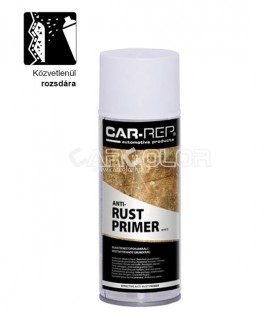

In stock
3,378 Ft
(tax incl.)
Online price
Anti-corrosion primer sprays for protecting metal surfaces during automotive refinishing, body repair and restoration. The range includes corrosion-resistant primers, epoxy primer aerosols and etch primers for different metal substrates.
Select the correct anti-corrosion primer according to the metal, surface condition and complete coating system. Bare steel, aluminium, galvanised metal and lightly corroded surfaces can require different primer technologies.
Anti-corrosion primer spray is used to prepare and protect suitable metal substrates where corrosion resistance is an important part of the complete refinishing system.
Depending on the individual product, these primers can be used during automotive body repair, on exposed metal areas, repaired panels and other compatible metal components.
The range includes several different technologies: conventional corrosion-resistant primers, 1K and 2K epoxy primers and acid etch primers. These systems are technically different and should not automatically be substituted for one another.
Depending on its approved substrates, an anti-corrosion primer can be used on:
Not every primer is suitable for every substrate listed above. Always check the technical data for the individual product.
Anti-corrosion primer and rust converter are different product types.
An anti-corrosion primer forms part of a coating system and provides corrosion protection and a suitable base for subsequent coatings according to its specification.
A rust converter is designed to chemically treat existing corrosion. Heavy or loose rust still requires appropriate mechanical preparation, and severe corrosion cannot simply be solved by applying conventional primer.
There is no universal answer.
Some corrosion-resistant primers are specifically approved by their manufacturers for correctly prepared, lightly corroded surfaces. Other primers require clean bare metal or a substrate prepared in a particular way.
Loose and flaking corrosion should always be removed. Perforated, severely thinned or structurally weakened metal requires proper body or metal repair rather than primer alone.
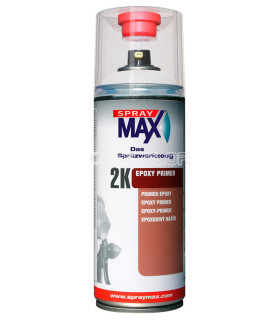
Epoxy primer spray is commonly used in automotive refinishing as an adhesion and corrosion-protection primer on compatible prepared metal substrates.
The range includes both 1K and genuine 2K epoxy primer aerosols. With a 2K product, the separate hardener component is activated immediately before use.
Once activated, chemical curing begins and the usable working life of the aerosol becomes limited.
Epoxy primer is not automatically compatible with every substrate or subsequent material, so always check its approved substrates and recoating procedure.
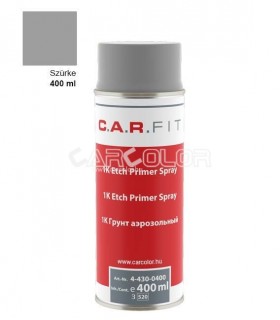
Etch primer is a specialist acid-containing primer designed to provide chemical adhesion and corrosion protection on suitable metal substrates.
Depending on the individual product, etch primers can be suitable for bare steel, aluminium or galvanised surfaces.
Coating compatibility is particularly important with etch primers. Not every filler, epoxy primer, primer surfacer or topcoat can be applied directly over every etch primer, so always follow the manufacturer's complete coating sequence.
1K primers are single-component and ready to use directly from the aerosol. They can provide a convenient solution for smaller repairs and local corrosion-protection work.
2K primer aerosols contain a separate hardener. Once activated, chemical cross-linking begins, which can provide different mechanical, chemical and coating properties depending on the formulation.
The correct choice is not simply which system is “better”, but which one is compatible with the substrate and complete refinishing process.
Bare steel should be free from loose rust, grease, oil, silicone and sanding contamination before priming.
A suitable anti-corrosion primer can form an important protective layer directly above the prepared metal, but it must also be compatible with all subsequent coatings.
Aluminium and galvanised steel behave differently from conventional bare steel, so not every primer provides adequate adhesion to these substrates.
Certain epoxy and etch primer systems are specifically approved for aluminium, galvanised or zinc-coated surfaces. Always confirm the substrate approval for the individual product.
If a rust converter or other corrosion-treatment product has already been used, only apply primers that are compatible with that treatment system.
Application differs significantly between conventional, epoxy and etch primers, so always follow the individual technical data sheet.
Not necessarily. The primary purpose of corrosion-protection primer is not always surface levelling.
If further refinement is required, a compatible primer surfacer can be applied over the corrosion-protection layer where the coating system permits it.
Some epoxy primers also provide useful filling properties, so the exact coating sequence varies by product.
On small areas of local surface corrosion, rust removal followed by an appropriate anti-corrosion primer can form part of the repair process.
If the panel is perforated, severely thinned or structurally weakened, primer is not a sufficient repair. Welding, panel repair or component replacement may be necessary.
Use corrosion-protection aerosols according to their technical and safety information. Provide suitable ventilation and use the specified respiratory, eye and skin protection.
2K aerosols require particular attention to the working environment and respiratory protection specified in the safety data sheet.
It is used to protect correctly prepared metal substrates against corrosion and to provide a suitable base for subsequent coatings according to the individual primer specification.
It depends on the product. Some primers are approved for correctly prepared light corrosion, while others require clean bare metal. Loose and flaking rust should always be removed.
Anti-corrosion primer forms a protective primer layer within a coating system. Rust converter chemically treats existing corrosion. They are different products and are not automatically interchangeable.
Epoxy primer is a resin-based adhesion and corrosion-protection coating, while etch primer uses an acidic chemical mechanism to promote adhesion to suitable metals. Their coating sequences and compatible subsequent materials can differ.
Only where the individual primer is specifically approved for aluminium. Certain epoxy and etch primers are suitable, while other corrosion-resistant primers are not.
It depends on the product and coating sequence. Some primers require sanding, while others can be recoated directly within a specified recoat window.
Not always. Where additional surface refinement is needed, a compatible filler primer may be applied, while some epoxy primers already provide useful filling properties.
Please sign in first.
Sign inCreate a free account to save loved items.
Sign inCreate a free account to use wishlists.
Sign in





 English
 Magyar
&media=https://www.carcolor.hu/shop/12217-large_default/car-rep-anty-rust-primer-white-400ml.jpg)
&media=https://www.carcolor.hu/shop/12220-large_default/car-rep-anty-rust-primer-black-400ml.jpg)
&media=https://www.carcolor.hu/shop/12226-large_default/car-rep-anty-rust-primer-red-400ml.jpg)
&media=https://www.carcolor.hu/shop/12208-large_default/car-rep-anty-rust-primer-grey-400ml.jpg)
&media=https://www.carcolor.hu/shop/17894-large_default/spraymax-2k-epoxy-primer-filler-400ml.jpg)
&media=https://www.carcolor.hu/shop/13326-large_default/car-fit-1k-etch-acid-primer-gray-400ml.jpg)
&media=https://www.carcolor.hu/shop/16671-large_default/car-fit-1k-epoxy-primer-400ml.jpg)